


7 Modern (1700–1840)
Marked by population growth, agricultural and industrial change, and the increasing reach of central government into local affairs.
Records are generally more systematic, allowing greater insight into individuals and households, though coverage varies by record type and locality.
Total events: 87 for the Parish of Millbrook
Earliest event: 1700 Latest event: 1840
5 entity types represented; 12 categories represented
These 87 events account for approximately 23.1 percent of the Millbrook parish timeline (87 of 376 events).
| Date | 1700 | Category | Administrative | Entity | Parish | Century | 17th |
|---|
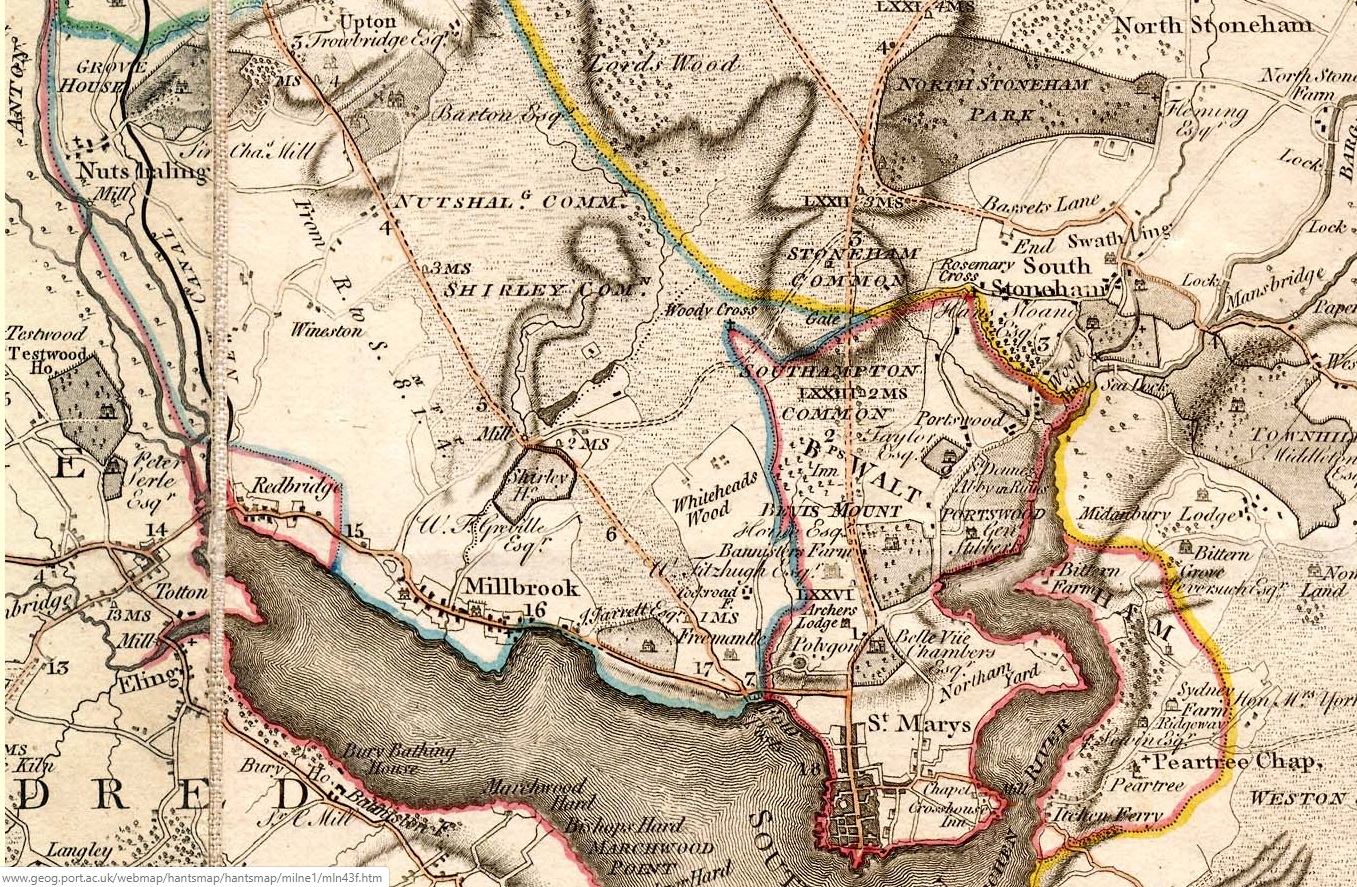
Shirley area associated with Millbrook
Shirley historically linked with Millbrook/South Stoneham prior to urban parish formalisation
| Date | 1700 | Category | Administrative | Entity | Parish | Century | 17th |
|---|
Shirley area associated with Millbrook
Shirley historically linked with Millbrook and South Stoneham prior to urban parish formation
| Date | 1700 | Category | Administrative | Entity | Parish | Century | 17th |
|---|
Shirley associated with Millbrook
Shirley historically linked with Millbrook prior to civil parish formalisation
| Date | 1700 | Category | Social | Entity | National | Century | 17th |
|---|
The Agricultural Revolution
British Agricultural Revolution (Second Agricultural Revolution) The British Agricultural Revolution occurred between the 17th and 19th centuries and marked a significant increase in agricultural productivity in Britain. Key innovations included: Crop rotation systems, such as the Norfolk four-course system, which replaced the traditional fallow year with a rotation of wheat, turnips, barley, and clover/ryegrass. This improved soil fertility and provided fodder for livestock. Selective breeding of livestock, exemplified by the development of Shorthorn cattle, which increased meat and milk yields. Enclosure of land, consolidating small plots into larger, more efficient farms, which allowed for better management and investment in new techniques. Technological improvements, including new machinery, drainage systems, and scientific experimentation with crops. These changes increased food production faster than population growth, contributing to a population boom in England and Wales from 5.5 million in 1700 to over 9 million by 1801. The rise in productivity also freed labor from agriculture, supplying workers for the Industrial Revolution.
| Date | 1707 | Category | Historical | Entity | National | Century | 18th |
|---|
Great Britain is created
The Treaty of Union between Scotland and England United Kingdom of Great Britain was made, with a British parliament in Westminster. Building on the Union of the Crowns of 1603, and creating a single parliament.
| Date | 1707 | Category | Historical | Entity | National | Century | 18th |
|---|
The countries of England Wales and Scotland are known as Great Britian
The countries of England Wales and Scotland are known as Great Britian, with Ireland as a separate Kinkdom ruled by Great Britian
| Date | 1714 | Category | Historical | Entity | National | Century | 18th |
|---|
The Georgian era
The start of the Georgian era. Queen Anne died and her nearest Protestant relative became the new king, George I. He was from Germany. This was the start of a time of great wealth and colonial expansion. The era ended in 1830
| Date | 1714 | Category | Military | Entity | National | Century | 18th |
|---|
The Royal Navy was the world's most powerful navy.
The Royal Navy was the world's most powerful navy. The Royal Navy played a key part in establishing and defending the British Empire, and four Imperial fortress colonies and a string of imperial bases and coaling stations secured the Royal Navy's ability to assert naval superiority.
| Date | 1715 | Category | Historical | Entity | National | Century | 18th |
|---|
First Jacobite Rebellion
Catholics who wanted James II of England back on the throne (called Jacobites) fought Protestants who supported the new king George I. The fighting ended when the grandson of James II (known as ‘Bonnie Prince Charlie’) lost the Battle of Culloden in 1746.
| Date | 1720 | Category | Economic | Entity | National | Century | 18th |
|---|
South Sea Bubble
Thousands of people went bankrupt and many took their own life when the price of shares in the South Sea Company collapsed.
| Date | 1721 | Category | Historical | Entity | World | Century | 18th |
|---|
The Russian Empire
The Russian Empire was proclaimed in 1721 by Peter the Great, the tsar who transformed Russia from a regional power into an empire at the expense of Sweden in the north and the Ottoman Empire in the south. After that, the Russians began a long trek east, conquering new lands in Siberia and crossing the Bering Strait into North America (as shown in this 1775 map). At its height at the end of the 19th century, the Russian Empire covered roughly a sixth of all the land on Earth and encompassed 125 million people.
| Date | 1740 | Category | Historical | Entity | World | Century | 18th |
|---|
End of First French colonial empire
In the middle of the 18th century, a series of colonial conflicts began between France and Britain, which ultimately resulted in the destruction of most of the first French colonial empire and the near-complete expulsion of France from the Americas. These wars were the War of the Austrian Succession (1740–1748), the Seven Years' War (1756–1763), the American Revolution (1775–1783), the French Revolutionary Wars (1793–1802) and the Napoleonic Wars (1803–1815). It may even be seen further back in time to the first of the French and Indian Wars. This cyclic conflict is sometimes known as the Second Hundred Years' War. At the close of the Napoleonic Wars, most of France's colonies were restored to it by Britain, notably Guadeloupe and Martinique in the West Indies, French Guiana on the coast of South America, various trading posts in Senegal, the Île Bourbon (Réunion) in the Indian Ocean, and France's tiny Indian possessions; however, Britain finally annexed Saint Lucia, Tobago, the Seychelles, and the Isle de France (now Mauritius).
| Date | 1750 | Category | Social | Entity | Parish | Century | 18th |
|---|
Enclosure of Shirley Common and Whithed Wood
Parish-specific enclosure affecting Shirley Common and Whithed Wood; contributed to labour displacement and later urban development
| Date | 1750 | Category | Social | Entity | National | Century | 18th |
|---|
Enclosures
In England the movement for enclosure began in the 12th century and proceeded rapidly in the period 1450–1640, when the purpose was mainly to increase the amount of full-time pasturage available to manorial lords. Much enclosure also occurred in the period from 1750 to 1860, when it was done for the sake of agricultural efficiency. By the end of the 19th century the process of the enclosure of common lands in England was virtually complete.
| Date | 1750 | Category | Social | Entity | National | Century | 18th |
|---|
The Highland Clearances
Over 100 years, people in Highland Scotland were forced from their villages and farms so the land could be used for sheep. Thousands of people emigrated, many to Ireland or North America. The Highland Clearances (Scottish Gaelic: Fuadaichean nan Gàidheal) occurred in two main phases from around 1750 to 1860, involving the displacement of thousands of Highlanders from their ancestral lands. These evictions fundamentally transformed the social, economic, and cultural landscape of the Highlands, dismantling the traditional clan system and prompting widespread emigration. The first phase was largely driven by economic pressures and agricultural improvement. Landlords, many facing substantial debts, sought to increase income by replacing small tenant farms with large-scale sheep pastures, which were more profitable. This involved the enclosure of communal fields previously managed under the run rig system and the reduction of tenants from farmers to crofters, often forcing them into industries like fishing, quarrying, or kelp processing. The second phase arose from overcrowded crofting communities that could no longer sustain themselves due to famine, declining industries, and population pressures. Landowners increasingly resorted to assisted emigration, paying for tenants to relocate to North America or Australia, leaving them with little choice but to leave. The Highland Potato Famine further intensified these evictions.
| Date | 1750 | Category | Social | Entity | National | Century | 18th |
|---|
The Industrial Revolution
The Industrial Revolution was a transformative period that shifted economies from agrarian and handicraft-based systems to mechanized, industrialized production, beginning in Britain in the mid-18th century and spreading globally. Origins and Timeline The Industrial Revolution began around 1750 in Great Britain, following the Second Agricultural Revolution, and spread to continental Europe and the United States by the early 19th century, with Japan industrializing later in the 19th century. Historians often divide it into two phases: the First Industrial Revolution (mid-18th to early 19th century), focused on textiles, iron, and steam power, and the Second Industrial Revolution (mid-19th to early 20th century), characterized by steel, electricity, petroleum, and mass production. Key Technological Innovations Textiles: Mechanized cotton spinning (water and steam-powered), the spinning jenny, power loom, and cotton gin dramatically increased productivity. Iron and Steel: Innovations in smelting iron with coke improved quality and reduced costs, fueling construction and machinery. Steam Power: Steam engines, improved by James Watt, powered factories, locomotives, and ships, enabling large-scale industrial production. Transportation and Communication: Railways, steamships, telegraphs, and later automobiles and telephones revolutionized movement and information exchange. Economic and Social Impacts The Industrial Revolution transformed economies from agriculture-based to industrialized, increasing productivity, wealth, and the size of the middle class. However, it also created harsh working conditions, particularly for women and children, leading to long hours, low wages, and unsafe environments, which eventually spurred the trade union movement. Urbanization accelerated as people moved to cities for factory work, altering social structures and lifestyles. Factors Enabling Industrialization Several factors contributed to Britain’s early industrialization: High agricultural productivity freeing labor and ensuring food surpluses. Abundant natural resources like coal, iron, and water power. Political stability, supportive legal systems, and access to financial capital.
| Date | 1753 | Category | Legislation | Entity | National | Century | 18th |
|---|
Marriage Act 1753 (Hardwicke's Act)
Clandestine Marriages Act 1753 Required marriages to be performed in Anglican church with banns or licence. First effective marriage registration.
| Date | 1756 | Category | Military | Entity | World | Century | 18th |
|---|
The Seven Years’ War and the Revolutionary War
The Revolutionary War and the Seven Years’ War were separate conflicts, though the latter set the stage for the former. Seven Years’ War (1756–1763) The Seven Years’ War was a global conflict involving major European powers, including Britain, France, Prussia, Austria, Spain, and others, fought across Europe, North America, and Asia. In North America, it is often called the French and Indian War (1754–1763), where British and French forces, along with their respective Native American allies, fought over control of the Ohio River Valley and other territories. The war ended with the Treaty of Paris in 1763, which gave Britain control of French territories in North America, significantly expanding its empire but also leaving it with massive debt. American Revolutionary War (1775–1783) The American Revolutionary War began more than a decade later, in 1775, as a direct result of rising tensions between Britain and its American colonies. These tensions were fuelled by new taxes and regulations imposed by Britain to recover debts from the Seven Years’ War, such as the Stamp Act and Townshend Acts. The war involved the thirteen American colonies fighting for independence from British rule, culminating in the Declaration of Independence in 1776 and eventual victory with the Treaty of Paris in 1783. Connection Between the Wars While the Seven Years’ War was not the Revolutionary War, it created conditions that contributed to the American Revolution: Britain’s financial strain from the war led to increased taxation of the colonies. The removal of French power in North America reduced the colonies’ reliance on Britain for protection, encouraging a sense of independence. Colonial military experience gained during the French and Indian War, including figures like George Washington, helped prepare leaders for the Revolutionary War. In summary, the Seven Years’ War and the Revolutionary War were distinct conflicts, separated by over a decade, but the outcomes and consequences of the Seven Years’ War directly influenced the causes and context of the American Revolution. Some say that the intervention by France into the American Revolutionary War, and the debt incurred, contributed to the French Revolution. Winston Churchill later famously referred to the conflict (Seven Years) as the "First World War" due to its truly global scale, with major campaigns spanning four continents. I would be inclied to group the two together and count it as the "First World War" .
| Date | 1757 | Category | Transport | Entity | National | Century | 18th |
|---|
The Canal Era
The Canal Era in the UK was marked by a period of rapid industrial growth and economic development. The canal network played a crucial role in transporting raw materials to factories and finished goods to consumers, significantly speeding up the process and reducing costs. The most notable canal during this era was the Bridgewater Canal, which connected the Duke of Bridgewater's coal mines to Manchester and Liverpool, halving the coal price in the town overnight. This canal was a key player in the Industrial Revolution, facilitating the movement of coal and other materials essential for the new industrial processes. The canal era also saw the rise of canal mania, a period of over a decade where many new canals were promoted, driven by the belief that they would create wealth and improve trade. However, not all canals were successful, with some being abandoned or failing to generate profit. Despite the challenges, the canal network remained a vital part of the UK's economy, and its legacy continues to influence the country's transportation and leisure sectors. The canal network of the United Kingdom played a vital role in the Industrial Revolution. The UK was the first country to develop a nationwide canal network which, at its peak, expanded to nearly 4,000 miles (6,400 kilometres) in length. The canals allowed raw materials to be transported to a place of manufacture, and finished goods to be transported to consumers, more quickly and cheaply than by a land based route. The canal network was extensive and included feats of civil engineering such as the Anderton Boat Lift, the Manchester Ship Canal, the Worsley Navigable Levels and the Pontcysyllte Aqueduct. The majority of the network was built in the "Golden Age" of canals, between the 1770s and the 1830s. From 1840, the canals began to decline, because the growing railway network was a more efficient means of transporting goods. From the beginning of the 20th century, the road network became progressively more important; canals became uneconomic and were abandoned. In 1948, much of the network was nationalised. Since then, canals have been increasingly used for recreation and tourism.
| Date | 1775 | Category | Military | Entity | National | Century | 18th |
|---|
The American Revolutionary War
The 13 English / British North American Colonies fought the British for Independence
| Date | 1776 | Category | Military | Entity | National | Century | 18th |
|---|
Declaration of Independence in 1776, marking the birth of the United States of America.
Declaration of Independence in 1776, marking the birth of the United States of America.
| Date | 1778 | Category | Social | Entity | National | Century | 18th |
|---|
Papists Act 1778
An Act for relieving His Majesty's subjects professing the popish religion from certain penalties and disabilities imposed on them by an Act made in the eleventh and twelfth years of the reign of King William the Third, intituled "An Act for the further preventing the growth of popery." By this act, an oath was imposed, which besides a declaration of loyalty to the reigning sovereign, contained an abjuration of the Pretender, and of certain doctrines attributed to Roman Catholics, such as that excommunicated princes may lawfully be murdered, that no faith should be kept with heretics, and that the Pope had neither temporal nor as spiritual jurisdiction in Great Britain.
| Date | 1780 | Category | Economic | Entity | County | Century | 18th |
|---|
Enclosure Acts - Hampshire
Various enclosure acts affecting Hampshire parishes.
| Date | 1780 | Category | Social | Entity | National | Century | 18th |
|---|
The Gordon Riots
A series of riots in London against Catholic emancipation, which resulted in significant violence and property destruction.
| Date | 1785 | Category | Social | Entity | National | Century | 18th |
|---|
The Peterloo Massacre
A peaceful pro-democracy rally in Manchester was violently broken up by cavalry, leading to the deaths of at least 15 people
| Date | 1789 | Category | Historical | Entity | World | Century | 18th |
|---|
French Revolution
The French Revolution (1789–1799) was a decade-long period of radical social, political, and economic upheaval in France that dismantled the monarchy, reshaped society, and laid the foundations for modern democracy. Causes of the Revolution The French Revolution arose from a combination of long-term social inequalities and immediate economic crises. France’s population was divided into three estates: the clergy (First Estate), the nobility (Second Estate), and the commoners (Third Estate), who made up about 98% of the population but had little political power and bore the heaviest tax burden. The bourgeoisie, wealthy merchants and professionals, resented their exclusion from political influence despite their economic power. Financial mismanagement, extravagant royal spending, and France’s costly involvement in the American Revolution left the state nearly bankrupt. Poor harvests, rising bread prices, and widespread poverty fueled social unrest. King Louis XVI’s indecisive policies and resistance to reform further exacerbated tensions.
| Date | 1791 | Category | Social | Entity | National | Century | 18th |
|---|
Roman Catholic Relief Act 1791
An act of the Parliament of Great Britain passed in 1791 which partially reduced discrimination against Roman Catholics and permitted them to more fully participate in public life, as part of the process of Catholic emancipation in Great Britain. It permitted Catholics to practise law, practise their religion, and establish Catholic schools, with significant restrictions. Chapels, schools, officiating priests and teachers had to be registered, and children of Protestants were not permitted to attend. Catholics were not permitted to as assemblies with locked doors, and chapels could not have steeples or bells. Priests were not permitted to wear vestments or celebrate liturgies in the open air. Monastic orders and endowments of schools and colleges were prohibited. Political sentiment for reform was helped along by the signing of the Edict of Versailles in France in 1787, which gave non-Catholic French subjects full legal status in a kingdom where Catholicism had always been the state religion.
| Date | 1791 | Category | Technological | Entity | National | Century | 18th |
|---|
Charles Babbage is considered the "father of the computer"
Charles Babbage is considered the "father of the computer" for conceiving the first mechanical and programmable computing devices. Charles Babbage (1791–1871) was an English mathematician, philosopher, inventor, and mechanical engineer who originated the concept of a digital programmable computer. He is best known for designing the Difference Engine, a mechanical calculator intended to produce mathematical tables, and the Analytical Engine, which contained most of the fundamental elements of modern computers, including programmability inspired by the Jacquard loom. Although these machines were never fully built during his lifetime, his designs laid the groundwork for future computing technology.
| Date | 1792 | Category | Historical | Entity | World | Century | 18th |
|---|
The French Revolutionary and Napoleonic Wars
The French Revolutionary and Napoleonic Wars (sometimes called the Great French War or the Wars of the Revolution and the Empire) were a series of conflicts between the French and several European monarchies between 1792 and 1815. They encompass first the French Revolutionary Wars against the newly declared French Republic and from 1803 onwards, the Napoleonic Wars against First Consul and later Emperor Napoleon Bonaparte. They include the Coalition Wars as a subset: seven wars waged by various military alliances of great European powers, known as Coalitions, against Revolutionary France – later the First French Empire – and its allies between 1792 and 1815: War of the First Coalition (April 1792 – October 1797) War of the Second Coalition (November 1798 – March 1802) War of the Third Coalition (April 1805 – July 1806) War of the Fourth Coalition (October 1806 – July 1807) War of the Fifth Coalition (April – October 1809) War of the Sixth Coalition (March 1813 – May 1814) War of the Seventh Coalition, also known as the Hundred Days (March – July 1815) Although the Coalition Wars are the most prominent subset of conflicts of this era, some French Revolutionary Wars such as the French invasion of Switzerland, and some Napoleonic Wars such as the French invasion of Russia and the Peninsular War, are not counted amongst the "Coalition Wars" proper.
| Date | 1794 | Category | Transport | Entity | Parish | Century | 18th |
|---|
Andover Canal provided waterborne access near Millbrook
Canal termination at Redbridge supported trade and movement affecting Millbrook parish
| Date | 1795 | Category | People | Entity | Parish | Century | 18th |
|---|
LT Colonel William Hewett
The Hewett family were the last owners of the Freemantle Park estate before it was built on. William Hewett was the last surviving officer of the Battle of Waterloo in 1815 where the Duke of Wellington’s forces defeated Napoleon’s army. William died in 1891 and is buried with his wife in the Old Cemetery on the Common.
| Date | 1797 | Category | Military | Entity | National | Century | 18th |
|---|
The last invasion of Britain
The last invasion of Britain is launched by the French near Fishguard, Wales, during the French Revolutionary Wars
| Date | 1798 | Category | Historical | Entity | National | Century | 18th |
|---|
The Irish Rebellion
Irish people fought against British rule, with support from the French. Nearly 30,000 people died. Eventually, the British won.
| Date | 1799 | Category | Social | Entity | National | Century | 18th |
|---|
Social Revolutions
UK Social Revolutions The UK has experienced several significant social revolutions throughout its history, each contributing to the evolution of social justice and equality. Here are some key moments in UK social history: 1799: The Combination Act was enacted to prevent unlawful combinations of workers, which was a precursor to the establishment of trade unions. 1801: The official Census reported a population of 10.5 million, marking a pivotal moment in the UK's demographic history. 1802: The Factory Act limited the working hours of apprentices to 12 per day and prohibited night work, reflecting the growing industrialization of the UK. 1811: The National Society for the Education of the Poor was founded, aiming to improve the education of the working classes. 1811-17: The Luddite movement, primarily textile artisans in Nottinghamshire and Yorkshire, protested against the use of machinery in factories, believing it would diminish employment. 1815: The Corn Laws were introduced, cutting off less expensive foreign wheat, which was a significant factor in the economic struggles of the time. 1820-1850: The rapid growth of the British economy led to a shift in the standard of living for urban lower classes, with a respectable paid occupation for a middle-class woman being governess or dressmaker. 1821: The population of England and Wales was 11.5 million, and the Bank of England began functioning as a central bank. 1823: The Anti-slavery Society was formed, reflecting the growing abolitionist movement in the UK. 1824: The Combinations Acts of 1799 and 1800 were repealed, and trade unions were legalized, marking a significant step towards workers' rights. These events illustrate the UK's commitment to social reform and the gradual progress towards a more equitable society. The UK's social revolutions have been marked by a continuous struggle for justice, equality, and the betterment of the working class and marginalized communities.
| Date | 1800 | Category | Administrative | Entity | Parish | Century | 18th |
|---|
Freemantle area developed within Millbrook / Southampton
Freemantle emerged as an urban district rather than an ancient parish
| Date | 1800 | Category | Administrative | Entity | Parish | Century | 18th |
|---|
Freemantle area developed within Millbrook / Southampton
Freemantle emerged as urban district rather than ancient parish
| Date | 1800 | Category | Economic | Entity | Parish | Century | 18th |
|---|
Rapid urbanisation linked to Southampton docks
Industrial growth and dock employment drove rapid population increase and inward migration
| Date | 1800 | Category | Transport | Entity | Parish | Century | 18th |
|---|
Proximity and access to Southampton docks
Dock expansion created major transport hub influencing migration and employment
| Date | 1800 | Category | Legislation | Entity | National | Century | 18th |
|---|
Census Act 1800
Census Act was made law by royal assent on 31 December 1800
| Date | 1801 | Category | Registration | Entity | Parish | Century | 19th |
|---|
Parish included in census enumeration districts
Early census enumeration
| Date | 1801 | Category | Legislation | Entity | National | Century | 19th |
|---|
The UK, United Kingdom of Great Britain and Ireland, is created
1801: The UK is created. Because of the Irish rebellion, Britain dissolved the Irish parliament and moved its responsibilities to the British parliament. This created the United Kingdom of Great Britain and Ireland.
| Date | 1801 | Category | Historical | Entity | National | Century | 19th |
|---|
The claim of the British monarchy to the French crown was officially dropped form the royal style.
The claim of the British monarchy to the French crown was officially dropped. A claim from 1340 or even 1066.
| Date | 1801 | Category | Historical | Entity | National | Century | 19th |
|---|
The combined countries are called The United Kingdom of Great Britain and Ireland.
| Date | 1804 | Category | Transport | Entity | National | Century | 19th |
|---|
The period of Steam Railways
The period of steam railways in the UK began with the invention of the steam locomotive by Richard Trevithick in 1804, which was the first to run on purpose-built tracks. The first public freight railway was the Surrey Iron Railway in 1807, and the first commercial use of locomotives occurred in 1812. By 1845, over 2,440 miles of railway were open, transporting millions of passengers and goods across the country. The dominance of steam railways continued until the early 20th century, with significant developments like the Liverpool and Manchester Railway in 1829, which was the world's first inter-city railway. The decline of steam railways began in the 1930s, leading to the phased-out of steam locomotives by the 1960s. Many were shut in the 1960 due to the popularisation of the car and the resulting decline in railway passenger numbers. The closures were driven by the report of Dr Beaching as an attempt to save the failing railways.
| Date | 1805 | Category | Military | Entity | National | Century | 19th |
|---|
The Battle of Trafalgar
The Battle of Trafalgar (21 October 1805) was a decisive British naval victory that established long-term British naval supremacy and thwarted Napoleon’s plans to invade England. British fleet: 27 ships of the line, led by Admiral Nelson. Franco-Spanish fleet: 33 ships (18 French, 15 Spanish), including the massive Santísima Trinidad, commanded by Villeneuve. Nelson’s fleet was outnumbered but highly trained, while the French/Spanish crews were inexperienced and poorly coordinated. The battle was a resounding British victory: French/Spanish losses: 18 ships captured or destroyed, approximately 14,000 men killed, wounded, or captured; Villeneuve was captured, and Admiral Federico Gravina later died from battle wounds. British losses: No ships lost, around 1,500 casualties; Nelson was mortally wounded during the engagement. The victory confirmed British naval supremacy, effectively ending Napoleon’s immediate threat of invading Britain.
| Date | 1807 | Category | Legislation | Entity | National | Century | 19th |
|---|
Slave Trade Act 1807
Slave Trade Act 1807: Parliament passed this act to abolish the transatlantic slave trade, making it illegal to buy or sell enslaved Africans across the British Empire. However, slavery itself remained legal in the colonies
| Date | 1807 | Category | People | Entity | Parish | Century | 19th |
|---|
John Ralfs
John Ralfs (13 September 1807 – 14 July 1890) was an English botanist. Born in Millbrook, Hampshire, near Southampton, he was the second son of Samuel Ralfs, a yeoman of an old family in Hampshire. He has been commemorated in the names of many plant groups and taxa at many levels.
| Date | 1808 | Category | Social | Entity | National | Century | 19th |
|---|
Royal Navy played a crucial role in the abolition of slavery
The Royal Navy played a crucial role in the abolition of slavery by transitioning from supporting the slave trade to actively suppressing it after the 1807 Abolition of the Slave Trade Act. The British Parliament passed the Abolition of the Slave Trade Act in 1807, marking a significant turning point in the fight against the transatlantic slave trade. This legislation made it illegal for British subjects to engage in the slave trade, but enforcing this law proved challenging due to the ongoing demand for slave labor in the Americas and the continued operation of illicit slave traders. Establishment of the West Africa Squadron In response to the new law, the Royal Navy established the West Africa Squadron in 1808. This specialized naval unit was tasked with patrolling the West African coast to intercept slave ships and enforce the ban on the slave trade. Between 1808 and 1860, the squadron seized approximately 1,600 ships involved in the slave trade and freed around 150,000 Africans who were aboard these vessels.
| Date | 1812 | Category | Legislation | Entity | National | Century | 19th |
|---|
Rose's Act 1812
Standardised parish register formats. Required printed forms.
| Date | 1815 | Category | Historical | Entity | National | Century | 19th |
|---|
The Battle of Waterloo
The Battle of Waterloo, fought on June 18, 1815, marked Napoleon Bonaparte’s final defeat and the end of the Napoleonic Wars. The Battle of Waterloo took place near the village of Waterloo in present-day Belgium, then part of the United Kingdom of the Netherlands, on 18 June 1815. It was the decisive confrontation of the Hundred Days, the period following Napoleon’s escape from exile on Elba and his return to power in France. Napoleon’s French Imperial Army, numbering around 72,000 troops, faced a coalition of forces: the Anglo-allied army of 68,000 under the Duke of Wellington, composed of British, Dutch, Belgian, and German units, and approximately 45,000 Prussian troops commanded by Field Marshal Gebhard Leberecht von Blücher.
| Date | 1825 | Category | Social | Entity | National | Century | 19th |
|---|
London, the biggest city in the world
London became the biggest city in the world around 1825, surpassing Beijing due to its rapid industrialization and expansive colonial empire. This growth was fueled by the rise of mercantilism and colonialism, particularly in the 16th and 17th centuries, which allowed London to control vast resources and generate significant wealth. By 1827, London had a population of approximately 1.3 million, making it the largest city globally. In 1801, London passed one million residents and became the largest city in Western Europe since Rome; by 1840 it was the largest city in the history of the world, with over two million Londoners. By 1901, 6.5 million people lived in London It remained the largest city until 1926, when Tokyo overtook London as the most densely populated city. By 1939, London had a population of approximately 8.6 million, but it began to decline in the following decades, losing a significant portion of its population. Today, while London is no longer the largest city globally, it remains one of the most influential and important urban centers.
| Date | 1825 | Category | Transport | Entity | National | Century | 19th |
|---|
The Railway Era part 1
The rise and fall of the railways, many times, until being privatised during a period of potentially terminal decline.
| Date | 1825 | Category | Transport | Entity | National | Century | 19th |
|---|
The first passenger railway is built
It goes between Stockton and Darlington. Soon there were railways nearly everywhere.
| Date | 1829 | Category | Social | Entity | National | Century | 19th |
|---|
Catholic emancipation in 1829
Allowed Catholics to sit in Parliament, opened the way for a large Irish Catholic contingent. The re-establishment of the Roman Catholic ecclesiastical hierarchy in England in 1850 by Pope Pius IX, was followed by a frenzy of anti-Catholic feeling, often stoked by newspapers.
| Date | 1830 | Category | Historical | Entity | World | Century | 19th |
|---|
Second French colonial empire
The beginnings of the second French colonial empire were laid in 1830 with the French invasion of Algeria, which was fully conquered by 1903. The Second French colonial empire began to fall during the Second World War, when various parts were occupied by foreign powers (Japan in Indochina, Britain in Syria, Lebanon, and Madagascar, the United States and Britain in Morocco and Algeria, and Germany and Italy in Tunisia). However, control was gradually reestablished by Charles de Gaulle. The French Union, included in the Constitution of 1946, nominally replaced the former colonial empire, but officials in Paris remained in full control. The colonies were given local assemblies with only limited local power and budgets. There emerged a group of elites, known as "evolués", who were natives of the overseas territories but lived in metropolitan France
| Date | 1830 | Category | Social | Entity | Regional | Century | 19th |
|---|
Swing Riots
Agricultural labourers' uprising across southern England. Machine-breaking, arson, wage demands.
| Date | 1830 | Category | Social | Entity | Parish | Century | 19th |
|---|
Millbrook Disturbances
Local manifestation of agricultural unrest during Swing Riots period.
| Date | 1830 | Category | Social | Entity | Parish | Century | 19th |
|---|
Millbrook Disturbances
Local manifestation of agricultural unrest during Swing Riots period.
| Date | 1830 | Category | Social | Entity | National | Century | 19th |
|---|
Swing Riots
Agricultural labourers' uprising across southern England. Machine-breaking, arson, wage demands.
| Date | 1831 | Category | Historical | Entity | National | Century | 19th |
|---|
On the Origin of Species by Means of Natural Selection, or the Preservation of Favoured Races in the Struggle for Life by Charles Darwin
On the Origin of Species by Means of Natural Selection, or the Preservation of Favoured Races in the Struggle for Life is a work of scientific literature by Charles Darwin that is considered to be the foundation of evolutionary biology. It was published on 24 November 1859. Darwin's book introduced the scientific theory that populations evolve over the course of generations through a process of natural selection, although Lamarckism was also included as a mechanism of lesser importance. The book presented a body of evidence that the diversity of life arose by common descent through a branching pattern of evolution. Darwin included evidence that he had collected on the Beagle expedition in the 1830s and his subsequent findings from research, correspondence, and experimentation. Darwin recived a letter from Henslow proposing him as a suitable (if unfinished) naturalist for a self-funded supernumerary place on HMS Beagle with captain Robert FitzRoy, a position for a gentleman rather than "a mere collector". The ship was to leave in four weeks on an expedition to chart the coastline of South America. After delays, the (second) voyage began on 27 December 1831; it lasted almost five years. As FitzRoy had intended, Darwin spent most of that time on land investigating geology and making natural history collections, while HMS Beagle surveyed and charted coasts. He kept careful notes of his observations and theoretical speculations. At intervals during the voyage, his specimens were sent to Cambridge together with letters including a copy of his journal for his family.
| Date | 1832 | Category | Social | Entity | National | Century | 19th |
|---|
Extending the Franchise revolution
Clumination of several Reform Acts, and Representation of the People Acts
| Date | 1832 | Category | Social | Entity | National | Century | 19th |
|---|
The Representation of the People Act 1832, known as the first Reform Act or Great Reform Act:
As the 19th century progressed and the memory of the violent French Revolution faded, there was growing acceptance that some parliamentary reform was necessary. The unequal distribution of seats, the extension of the franchise and 'rotten boroughs' were all issues to be addressed. The Tory Prime Minister in 1830, Arthur Wellesley, First Duke of Wellington, was resolutely opposed to parliamentary reform. However, there was growing support for limited change within his party, primarily because partially extending the franchise would allow the wealth and influence of Britain's growing middle class to be exploited. When the Tory government was ousted later in 1830, Earl Grey, a Whig, became Prime Minister and pledged to carry out parliamentary reform. The Whig Party was pro-reform and though two reform bills failed to be carried in Parliament, the third was successful and received Royal Assent in 1832. The Bill was passed due to Lord Grey's plan to persuade King William IV to consider using his constitutional powers to create additional Whig peers in the House of Lords to guarantee the Bill's passage. On hearing of this plan, Tory peers abstained from voting, thus allowing the Bill to be passed but avoiding the creation of more Whig peers.
| Date | 1832 | Category | Electoral | Entity | Parish | Century | 19th |
|---|
Parish within Southampton Parliamentary Constituency
Reformed borough constituency
| Date | 1832 | Category | Legislation | Entity | National | Century | 19th |
|---|
The 1832 Reform Act weakened the pro-slavery lobby
The Reform Act weakened the pro-slavery lobby in Parliament, enabling the passage of abolition legislation.
| Date | 1834 | Category | Social | Entity | Regional | Century | 19th |
|---|
Tolpuddle Martyrs
Six agricultural labourers from Tolpuddle transported for forming a trade union. Major event in labour history.
| Date | 1834 | Category | Social | Entity | National | Century | 19th |
|---|
Tolpuddle Martyrs
Six agricultural labourers from Tolpuddle transported for forming a trade union. Major event in labour history.
| Date | 1834 | Category | Legislation | Entity | National | Century | 19th |
|---|
Poor Law Amendment Act 1834
Created Poor Law Unions and workhouses. Major reform of poor relief system.
| Date | 1834 | Category | Social | Entity | Parish | Century | 19th |
|---|
Poor relief administered via South Stoneham Workhouse
Early poor relief handled through South Stoneham PLU
| Date | 1834 | Category | Administrative | Entity | Parish | Century | 19th |
|---|
South Stoneham Poor Law Union
Poor Law administration
| Date | 1834 | Category | Social | Entity | National | Century | 19th |
|---|
Abolishment of slavery
Slavery becomes illegal across most of the British Empire after a new law is passed. There was a transitional period that lasted until 1838. Some areas had to wait until 1843: St Helena, Ceylon (now Sri Lanka) and places in India controlled by the East India Company. A new system of ‘indentured labourers’ was introduced to replace slavery; for many people it was not much better.
| Date | 1835 | Category | Legislation | Entity | National | Century | 19th |
|---|
The Municipal Corporations Act 1835
The Municipal Corporations Act 1835 (5 & 6 Will. 4. c. 76), sometimes known as the Municipal Reform Act, was an act of the Parliament of the United Kingdom that reformed local government in the incorporated boroughs of England and Wales.
| Date | 1836 | Category | Ecclesiastical Parish | Entity | Parish | Century | 19th |
|---|
Consecration of St James' Church, Shirley
Parish church established to serve growing Shirley area; early ecclesiastical separation from parent parish context
| Date | 1836 | Category | Ecclesiastical Parish | Entity | Parish | Century | 19th |
|---|
Shirley served by parish church of St James
Shirley functions as a distinct ecclesiastical community prior to later civil reorganisation
| Date | 1836 | Category | Legislation | Entity | National | Century | 19th |
|---|
Births and Deaths Registration Act 1836
Established civil registration of births, marriages and deaths from 1 July 1837.
| Date | 1836 | Category | Legislation | Entity | National | Century | 19th |
|---|
Marriage Act 1836
Allowed civil marriages and marriages in nonconformist chapels.
| Date | 1836 | Category | Legislation | Entity | National | Century | 19th |
|---|
Tithe Commutation Act of 1836
The Tithe Apportionment Act, particularly the Tithe Commutation Act of 1836, transformed the system of tithe payments in the UK from in-kind contributions to monetary payments, establishing a structured framework for landowners' obligations. Historical Context The Tithe Commutation Act of 1836 was a significant piece of legislation that aimed to reform the traditional system of tithes, which were originally paid as one-tenth of agricultural produce to the church. This system often led to disputes and dissatisfaction among landowners, particularly as agricultural practices evolved and the economy changed. The act allowed for the conversion of these in-kind payments into fixed monetary payments, known as tithe rentcharges.
| Date | 1837 | Category | Historical | Entity | National | Century | 19th |
|---|
The Victorian era
During the reign of Queen Victoria, the British Empire grew until it had a population of over 400 million people. It included countries like India, Australia and much of Africa. Most of these countries are now independent.
| Date | 1837 | Category | Registration | Entity | National | Century | 19th |
|---|
Civil registration of marriages introduced
Alternative civil system available
| Date | 1837 | Category | Registration | Entity | National | Century | 19th |
|---|
Civil registration of deaths introduced
Alternative civil system available
| Date | 1837 | Category | Registration | Entity | National | Century | 19th |
|---|
Civil Registration Begins
Civil registration of births, marriages and deaths commenced 1 July 1837.
| Date | 1837 | Category | Registration | Entity | Parish | Century | 19th |
|---|
Within South Stoneham Registration District
Early civil registration recorded under South Stoneham RD
| Date | 1837 | Category | Registration | Entity | National | Century | 19th |
|---|
Civil registration introduced
Act 1836 Meaning: A civil system began. Births could be registered. Registration was not yet compulsory.
| Date | 1840 | Category | Transport | Entity | Parish | Century | 19th |
|---|
London and South Western Railway connected Millbrook to Southampton
Early railway access linked parish to docks and regional network
| Date | 1840 | Category | Transport | Entity | Parish | Century | 19th |
|---|
Railway access established serving Millbrook area
Rail connection linked parish directly to docks and industrial employment
| Date | 1840 | Category | Transport | Entity | County | Century | 19th |
|---|
London and South Western Railway connected Millbrook to Southampton
Early railway access linked parish to docks and regional network
| Date | 1840 | Category | Transport | Entity | County | Century | 19th |
|---|
London and Southampton Railway Opens
Railway connection between London and Southampton via Nine Elms. Major transport infrastructure.
| Date | 1840 | Category | Legislation | Entity | National | Century | 19th |
|---|
Tithe Commutation Act 1836 (Surveys)
Tithe apportionment surveys conducted across England and Wales. Fixed reference point for parish boundaries.