




3 Early Medieval (411–899)
A transitional period following the end of Roman rule, marked by shifting kingdoms, cultural change, and the gradual spread of Christianity.
Documentary evidence is sparse and often retrospective; dates are frequently approximate and events tend to reflect political or ecclesiastical developments rather than everyday life.
Total events: 8 for the Parish of Millbrook
Earliest event: 449 Latest event: 886
2 entity types represented; 1 categories represented
These 8 events account for approximately 2.1 percent of the Millbrook parish timeline (8 of 376 events).
| Date | 449 | Category | Historical | Entity | National | Century | 5th |
|---|
Anglo-Saxons intergartion
| Date | 449 | Category | Historical | Entity | National | Century | 5th |
|---|
Anglo-Saxons invaded
Tribes from areas in Germany, the Netherlands and Denmark gradually moved into Britain. They were known as the Anglo-Saxons. The Celtic people were pushed to Wales, Cornwall, Devon, Somerset, Cumbria and Scotland. But by about 800, Cornwall, Devon and Somerset were part of the Anglo-Saxon kingdom of Wessex.
| Date | 519 | Category | Historical | Entity | National | Century | 6th |
|---|
Kingdom of the West Saxons, aka Kingdom of Wessex
| Date | 597 | Category | Historical | Entity | National | Century | 6th |
|---|
Christianity became popular in Anglo-Saxon kingdoms
| Date | 793 | Category | Historical | Entity | National | Century | 8th |
|---|
Vikings from Scandinavia arrived
Within 100 years the Vikings controlled much of central and north-eastern England, an area called the Danelaw.
| Date | 793 | Category | Historical | Entity | National | Century | 8th |
|---|
Vikings occupied the Northen part of England
| Date | 800 | Category | Historical | Entity | World | Century | 8th |
|---|
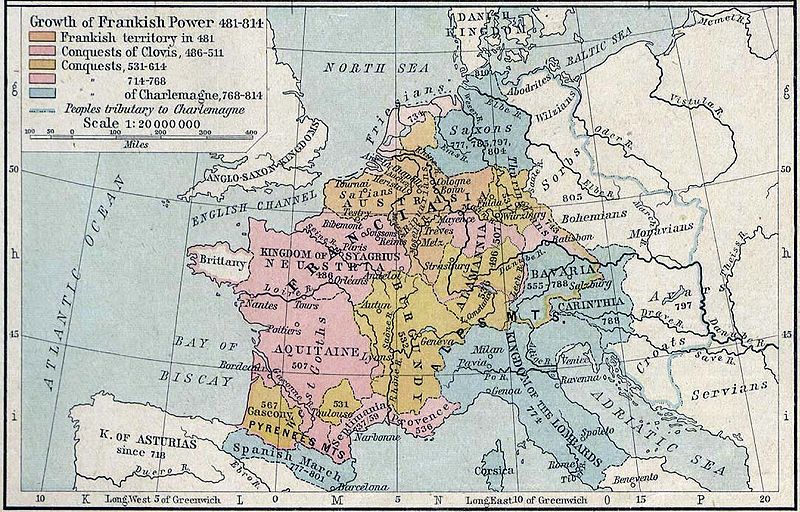
Holy Roman Empire
The Holy Roman Empire was a complex, decentralized European polity that existed from 800 (or 962) to 1806, centered on Germany and claiming continuity with the ancient Roman Empire. Origins and Early History The Holy Roman Empire traces its roots to Charlemagne, King of the Franks, who was crowned Emperor of the Romans by Pope Leo III on 25 December 800, reviving the imperial title more than three centuries after the fall of the Western Roman Empire in 476. After Charlemagne’s death, the empire fragmented, and the imperial title lapsed until 962, when Otto I of Saxony was crowned emperor by Pope John XII, marking the formal beginning of the Holy Roman Empire as a German-centered polity. The empire initially included Germany, Italy, and Burgundy, though over time its effective control over Italy and Burgundy diminished.
| Date | 886 | Category | Historical | Entity | National | Century | 9th |
|---|
Alfred the Great adopted the title 'King of the Anglo-Saxons'