


4 High Medieval (900–1349)
A period of growing stability and expansion following the Norman Conquest, marked by the consolidation of feudal lordship, the development of manorial and parish structures, and the increasing influence of the Church.
Records for this era become more regular but are still selective, focusing on landholding, lordship, and the Church rather than the wider population.
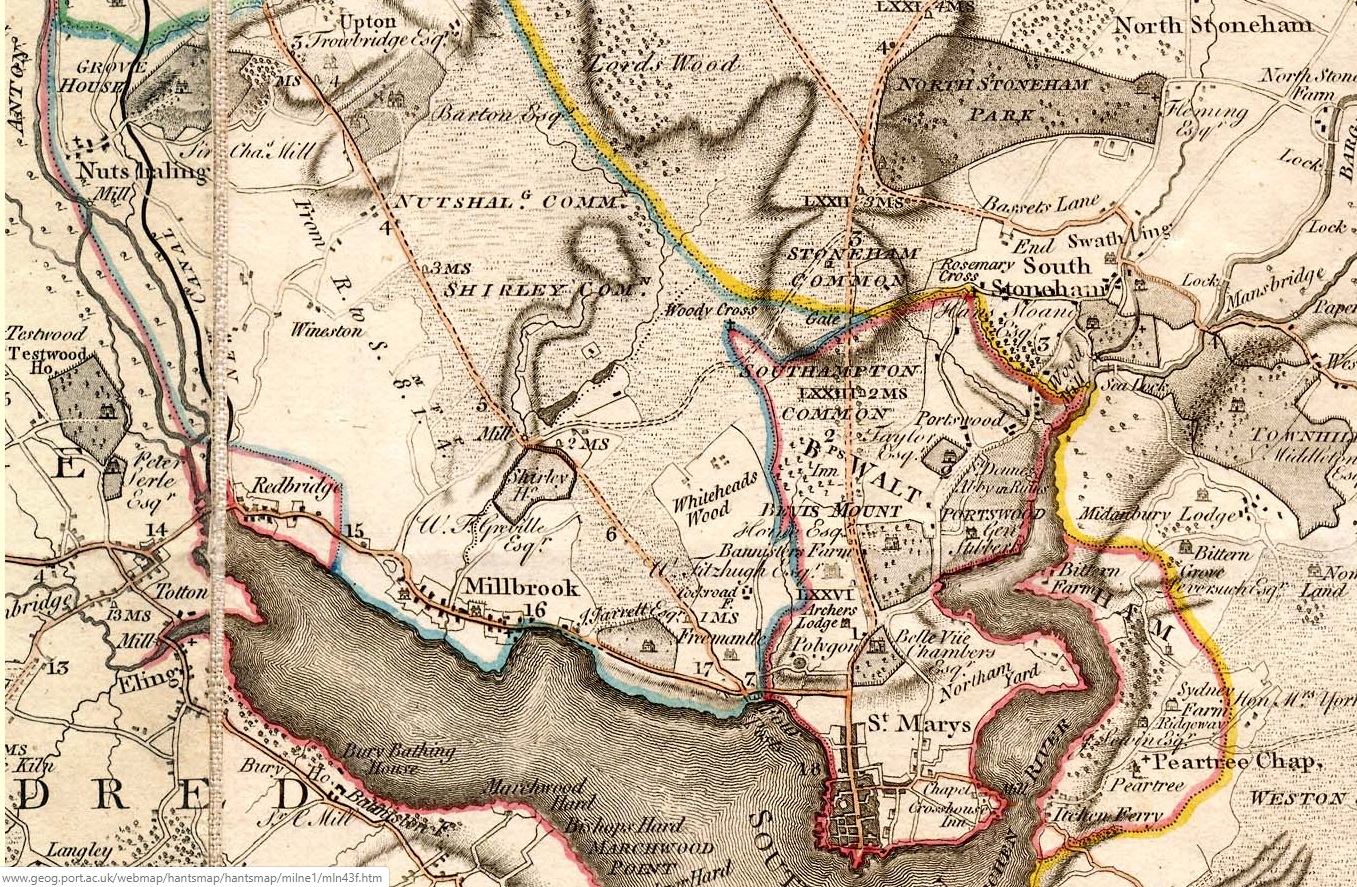
Total events: 48 for the Parish of Millbrook
Earliest event: 927 Latest event: 1348
4 entity types represented; 6 categories represented
These 48 events account for approximately 12.8 percent of the Millbrook parish timeline (48 of 376 events).
| Date | 927 | Category | Historical | Entity | National | Century | 10th |
|---|
Æthelstan conquered the Danish kingdoms and adopted the title 'King of the English'
Æthelstan conquered the Danish kingdoms, and when Æthelstan conquered the last surviving one, York he adopted the title 'King of the English'
| Date | 927 | Category | Historical | Entity | National | Century | 10th |
|---|
England as a Kingdom
| Date | 927 | Category | Historical | Entity | National | Century | 10th |
|---|
England created
| Date | 1000 | Category | Infrastructure | Entity | County | Century | 10th |
|---|
Redbridge Crossing
Causeway/crossing at Redbridge from Roman period. Key crossing point of River Test on route from Clausentum.
| Date | 1005 | Category | Historical | Entity | National | Century | 11th |
|---|
Scotland as a Kingdom
| Date | 1005 | Category | Historical | Entity | National | Century | 11th |
|---|
Scotland united
Rival northern Celtic groups formed one nation, Scotland.
| Date | 1066 | Category | Historical | Entity | National | Century | 11th |
|---|
England and France under one crown
The Norman Conquest of England in 1066 led to the establishment of a unified monarchy under the rule of William the Conqueror. This period saw the integration of England and France, with William's rule linking England to continental affairs and influencing the development of the English monarchy. The conquest resulted in the subordination of England to a Norman aristocracy, with William distributing estates to his followers and building castles to control his new kingdom. The Domesday Book, completed by 1086, was a significant record of the Great Survey of much of England and parts of Wales, reflecting the changes brought by the conquest.
| Date | 1066 | Category | Military | Entity | National | Century | 11th |
|---|
William, Duke of Normandy, invades England
The beginning of the Norman period of rule of England
| Date | 1067 | Category | Military | Entity | National | Century | 11th |
|---|
Castle capital of the world
Wales is often referred to as the "castle capital of the world," boasting over 600 castles, with around 427 still standing today, showcasing a rich history and architectural diversity. Wales has a long and tumultuous history, particularly following the Battle of Hastings in 1066, when William the Conqueror granted lands to his supporters, leading to the construction of numerous castles. These fortifications were built primarily by English lords to exert control over the Welsh territories, resulting in a landscape dotted with impressive military architecture.
| Date | 1086 | Category | Historical | Entity | Parish | Century | 11th |
|---|
Parish name attested as "Melebroc" / "Melebroche"
Domesday Book forms
| Date | 1086 | Category | Historical | Entity | Parish | Century | 11th |
|---|
Domesday Entry - Melebroc aka Melebroche
Meaning: “Mill stream / brook with a mill” Hundred: Redbridge Notes: Millbrook was recorded as a manor associated with the Redbridge area, later forming part of the parish structure you now have. Identification is secure.
| Date | 1086 | Category | Administrative | Entity | Parish | Century | 11th |
|---|
Within Redbridge Hundred
Hundred jurisdiction
| Date | 1086 | Category | Administrative | Entity | National | Century | 11th |
|---|
The Great Survey of England - Domesday Book
Survey of England to establish land ownership and usage for taxation
| Date | 1095 | Category | Historical | Entity | World | Century | 11th |
|---|
The First Crusade
1095: Pope Urban II calls for the First Crusade at the Council of Clermont, urging Christians to reclaim Jerusalem and aid the Byzantine Empire against Muslim advances 1096: The People’s Crusade, led by Peter the Hermit, departs for Constantinople but is largely destroyed by Seljuk forces. 1096–1099: The First Crusade, led by nobles such as Godfrey of Bouillon and Raymond of Toulouse, captures key cities including Nicaea, Antioch, and Jerusalem, establishing Crusader states like the Kingdom of Jerusalem. 1101: The Crusade of 1101, an early follow-up expedition, ends in defeat.
| Date | 1100 | Category | Historical | Entity | County | Century | 11th |
|---|
County referred to as Southamptonshire
Medieval usage of county name derived from Southampton (Hamtun); overlapped with Hants/Hampshire
| Date | 1135 | Category | Historical | Entity | National | Century | 12th |
|---|
The Anarchy
After King Henry I died, there was a brutal civil war for 19 years. This was because two people wanted the English crown: Henry’s daughter Matilda, and his nephew Stephen of Blois. Eventually Stephen won.
| Date | 1147 | Category | Historical | Entity | World | Century | 12th |
|---|
The Second Crusade
1147–1149: The Second Crusade is launched in response to the fall of Edessa but fails to achieve its objectives
| Date | 1169 | Category | Historical | Entity | National | Century | 12th |
|---|
England invaded Ireland
England invaded Ireland under the instruction of the Pope, to spread Christianity. The Norman invasion of Ireland began to establish English possessions in Ireland, with thousands of English and Welsh settlers arriving in Ireland. English control mostly was resigned to an area of Ireland known as The Pale, most of Ireland, large swaths of Munster, Ulster and Connaught remained independent of English rule until the Tudor and Stuart periods. (Hence "Beyond the Pale")
| Date | 1171 | Category | Historical | Entity | National | Century | 12th |
|---|
England / Britain rulled Ireland
England ruled the island of Ireland for over 700 years. Although there was some mixing of the English and Irish populations, mostly they lived side by side.
| Date | 1189 | Category | Historical | Entity | World | Century | 12th |
|---|
The Third Crusade
1189–1192: The Third Crusade, led by Richard the Lionheart, Philip II of France, and Frederick I Barbarossa, partially succeeds in defending Crusader states, though Jerusalem remains under Muslim control after Saladin’s victories.
| Date | 1196 | Category | Historical | Entity | World | Century | 12th |
|---|
The Mongol Empire
The largest contiguous empire the world has ever seen, the Mongol Empire stretched from Europe in the west to the Sea of Japan in the east, and from the Arctic Circle down to the Indian subcontinent. The empire reached its greatest extent in 1279 when Kublai Khan completed the conquest of China. By that time the Mongols' famously efficient messenger-riders, who could supposedly cover around 200 miles (322km) a day, would take more than a month to travel from one end of the empire to the other. The sudden rise of the Mongols began when a warlord named Temujin united the nomadic tribes of the Mongolian Plateau and took on a new name: Genghis Khan. His military supremacy came thanks to his extremely mobile armies staffed by mounted warriors who were deadly with bows and arrows. Enemies that did not submit were put down with extreme brutality, and the Mongols' ruthless reputation soon preceded them. Many smaller kingdoms chose to surrender rather than face the might of the Mongol horde. The Mongol Empire began to fracture after the death of its fourth Great Khan, Mongke, in 1259. Different factions vied for control, and, although Genghis' grandson Kublai technically ruled as Great Khan until his death in 1294, the empire was already coming apart. The empire would never again unite under a single ruler, and Karakorum, the grand capital of the Mongol Empire for just 50 years, soon fell into disrepair. It is now the site of Erdene Zuu Monastery (pictured) in central Mongolia.
| Date | 1200 | Category | Historical | Entity | Parish | Century | 12th |
|---|
Parish name variant "Melebrook"
Medieval spelling variation
| Date | 1202 | Category | Historical | Entity | World | Century | 13th |
|---|
The Fourth Crusade
1202–1204: The Fourth Crusade, initially aimed at Egypt, is diverted to Constantinople, resulting in the Sack of Constantinople and the establishment of the Latin Empire.
| Date | 1204 | Category | Historical | Entity | National | Century | 13th |
|---|
Treaty of Paris
After the Norman Conquest of England in 1066, the relationship between England and France became increasingly complex. The Anglo-Norman realm was established, but by the 13th century, tensions led to the dissolution of the Anglo-Norman alliance, culminating in the Treaty of Paris in 1204, which marked the end of English control over Normandy and the beginning of a permanent breach between the two nations.
| Date | 1204 | Category | Historical | Entity | World | Century | 13th |
|---|
Latin Empire
The Latin Empire was a Crusader state established in Constantinople in 1204, lasting until 1261, formed after the Fourth Crusade captured Byzantine territories. Origins and Foundation The Latin Empire, also known as the Latin Empire of Constantinople or Imperium Romaniae, was established by leaders of the Fourth Crusade on lands taken from the Byzantine Empire. Originally, the Crusade aimed to reclaim Jerusalem, but political and economic factors, including Venetian influence, diverted the army to Constantinople. In April 1204, the Crusaders captured and plundered the city, installing a Catholic emperor in place of the Eastern Orthodox Byzantine rulers, with Baldwin IX of Flanders crowned as Baldwin I on 16 May 1204.
| Date | 1212 | Category | Historical | Entity | World | Century | 13th |
|---|
The Children's Crusade
1212: The Children’s Crusade occurs, a largely unsuccessful popular movement of young people attempting to reach the Holy Land.
| Date | 1215 | Category | Historical | Entity | National | Century | 13th |
|---|
King John forced to sign the Magna Carta
King John was a bad king. His lords became angry and made him sign a document (the Magna Carta) that said he must follow the rules of England. It also limited how much the lords could be taxed and gave ‘free men’ the right to a fair trial. This idea of human rights was copied across the world.
| Date | 1215 | Category | Legislation | Entity | National | Century | 13th |
|---|
Magna Carta continus to impact Society
Ongoing effect of the Magna Carta
| Date | 1217 | Category | Historical | Entity | World | Century | 13th |
|---|
The Fifth Crusade
1217–1221: The Fifth Crusade targets Egypt but fails to secure lasting gains.
| Date | 1228 | Category | Historical | Entity | World | Century | 13th |
|---|
The Sixth Crusade
1228–1229: The Sixth Crusade, led by Holy Roman Emperor Frederick II, achieves a diplomatic agreement to regain Jerusalem temporarily without major battles.
| Date | 1248 | Category | Historical | Entity | World | Century | 13th |
|---|
The Seventh Crusade
1248–1254: The Seventh Crusade, led by Louis IX of France, focuses on Egypt but ends in failure.
| Date | 1270 | Category | Historical | Entity | World | Century | 13th |
|---|
The Eighth Crusade
1270: The Eighth Crusade, also led by Louis IX, targets Tunis and concludes with his death, marking the end of major Crusading efforts in the Holy Land.
| Date | 1271 | Category | Historical | Entity | World | Century | 13th |
|---|
Italian Explorers and Their Discoveries
Famous Italian Explorers and Their Discoveries The Italian explorers listed above have made significant contributions to the world through their adventurous journeys and discoveries. Here are some of their notable achievements: Marco Polo: His travels along the Silk Road in the 13th century provided Europeans with detailed accounts of Asian civilizations, influencing subsequent expeditions. Christopher Columbus: His 1492 transatlantic voyage to the Americas initiated sustained European contact with the Americas, establishing naval routes that enabled colonization and resource extraction. Amerigo Vespucci: His voyages in the early 1500s revealed that the lands along the eastern coast of South America were a distinct continent, separate from Asia, and his letters prompted cartographers to name the region "America" in his honor. John Cabot: His exploration of parts of the North American continent while sailing for England demonstrated viable northwest passages for fishing and trade. Giovanni da Verrazzano: His exploration of the North American coast from the Carolinas to Newfoundland in 1524 produced the first European descriptions of New York Harbor and confirmed the presence of a substantial landmass blocking direct Asian access. These explorers' contributions have had a lasting impact on history, connecting cultures, and expanding our understanding of the world. Their stories serve as a reminder of the importance of curiosity, ambition, and a strong sense of adventure in shaping our world.
| Date | 1273 | Category | Historical | Entity | World | Century | 13th |
|---|
Austrian (Habsburg) Empire
Austrian (Habsburg) Empire: A European continental empire with diverse populations across Austria, Bohemia, Hungary, and parts of Italy and Belgium, governed under a complex system of dynastic and regional authority.
| Date | 1284 | Category | Historical | Entity | National | Century | 13th |
|---|
England ruled Wales
| Date | 1284 | Category | Historical | Entity | National | Century | 13th |
|---|
England took control of Wales
King Edward I fought Welsh prince Llywelyn ap Gruffudd and he was killed in 1282. In 1284, the Statute of Rhuddlan made Wales part of England.
| Date | 1295 | Category | Electoral | Entity | Parish | Century | 13th |
|---|
Parish within Southampton Parliamentary Borough
Borough franchise prior to reform; limited electorate
| Date | 1296 | Category | Historical | Entity | National | Century | 13th |
|---|
Edward I invaded Scotland.
Edward I of England invaded Scotland
| Date | 1297 | Category | Historical | Entity | National | Century | 13th |
|---|
Scot William Wallace tried to fight the English
William Wallace tried to fight the English to free Scotland from English rule.
| Date | 1314 | Category | Historical | Entity | National | Century | 14th |
|---|
Battle of Bannockburn
Scottish king Robert the Bruce defeated the English at the Battle of Bannockburn
| Date | 1315 | Category | Historical | Entity | National | Century | 14th |
|---|
The Great Famine
The Great Famine. Over 7 years, at least 10% of people across Britain died from starvation caused by 2 years of very bad weather.
| Date | 1328 | Category | Historical | Entity | National | Century | 14th |
|---|
Scotland became independent in 1328.
| Date | 1337 | Category | Historical | Entity | National | Century | 14th |
|---|
The Hundred Years’ War
It started when King Edward III of England tried to invade France. 116 years later, France won.
| Date | 1338 | Category | Historical | Entity | Parish | Century | 14th |
|---|
French raid on Southampton impacts Millbrook parish
Raid on Southampton during early Hundred Years’ War affected surrounding parishes; loss of property and disruption beyond town walls
| Date | 1338 | Category | Historical | Entity | Parish | Century | 14th |
|---|
Construction and strengthening of Southampton town walls affects adjacent parishes
Defensive works following French raid required labour, materials, and resources from surrounding parishes including Millbrook
| Date | 1340 | Category | Historical | Entity | National | Century | 14th |
|---|
British monarchy continue to claim the French crown, and use it in their style
| Date | 1340 | Category | Historical | Entity | National | Century | 14th |
|---|
Edward III formalises his claim to the Frence Crown
Edward III delivered to Pope Benedict XII a document setting out the legal case justifying his claim. This was expanded upon in a more detailed legal brief used at a peace conference in 1344 presided over by Benedict's successor, Clement VI, at the papal palace at Avignon.
| Date | 1348 | Category | Historical | Entity | National | Century | 14th |
|---|
The Black Death
Bubonic plague killed 40% of people in one year. Many villages disappeared. But because of a labour shortage, the remaining peasants could suddenly choose who to work for and what to do. There was big social change.